Thursday, October 18, 2012

Showcase your promotions and get your customers’ attention

Shoppers are savvier than ever. They use social recommendations, web searches and smartphone apps to make informed purchase decisions. So how can a retailer stand out and get a shopper’s attention?

Today, we're rolling out a new way for retailers to reach shoppers at the moment of interest. Retailers can now add promotions to their product listings on Google Shopping to make them stand out. In addition, they can distribute their promotions on other Google properties such as Google Maps for Android and the Google Offers app, and attract shoppers to their store.
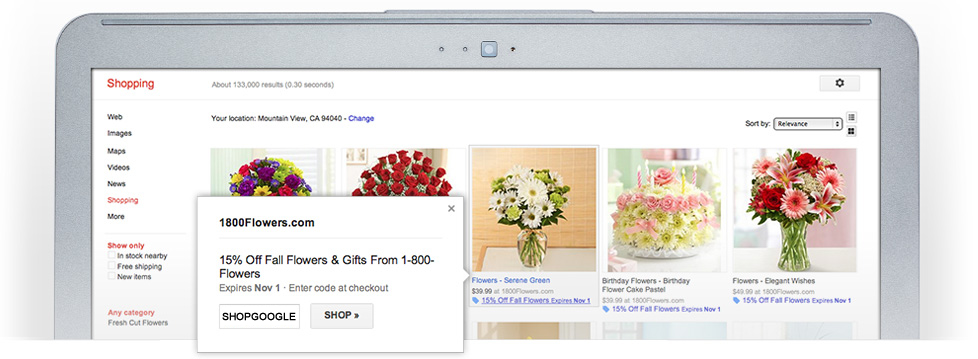

Promotions are highlighted in product listings on Google Shopping

In a few simple steps retailers can create a promotions list, map it to the right products in Google Shopping and upload to Google Merchant Center.  Our system supports user specific redemption codes and associated reporting, enabling retailers to measure the performance of each promotion.
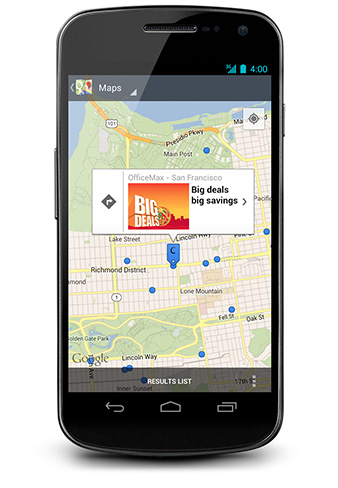
 
Shoppers can see nearby promotions while searching in Google Maps for Android

This is one of the many steps we’re taking to provide traffic, technology and tools to help retailers grow their business. Over 25 well-known U.S. retailers, including 1-800-flowers.com, OfficeMax®, Inc., Tommy Hilfiger, Express, Chico’s, Overstock, Guitar Center, Drugstore.com and Wayfair, are already part of this program. In the coming months, we plan to expand the program to include more retailers. If you are interested in featuring your promotions on Google properties, you can learn more here.


Posted by Nitin Mangtani, Group Product Manager, Google Offers and Michaela Feller, Product Manager, Google Shopping

Tuesday, October 2, 2012

Google Shopping: transition update and new functionality in time for the holidays

Over the last 4 months, Google Shopping has been moving to a commercial model built on Product Listing Ads. One of the reasons we decided to make this transition was to get better data from merchants in order to build a better shopping experience for users. We are very pleased with the participation from retailers in our new model and many are starting to report success.

Starting on October 17, Google Shopping results in the US will come only from merchants who are Product Listing Ads advertisers. We will be ranking these results based on relevance, with bidding as an additional factor. The ranking of natural search results on Google.com will not change.

Help for the Holidays 


For merchants who have not yet made the transition, it’s not too late to get your products on Google Shopping and optimized in time for the holiday season. You can do so by signing up for Product Listing Ads; please visit www.google.com/ads/shopping for more information. For merchants attending SMX East in New York City this week, we would love to hear from you during the Google Shopping Q&A session on October 4 at 2:30 PM local time. We look forward to making ourselves available to answer any questions you may have regarding Product Listing Ads on Google Shopping.

For help optimizing your Product Listing Ads, check out our Google Shopping best practices guide or watch 
our optimization video. Additionally, we’ll be hosting a ‘Bidding Strategies for the Holidays’ Hangout on Air on October 19 at 10:00am PST. Visit the Ads Google+ page to join the Hangout.

A New Way to Optimize Campaigns

We’ve gotten a lot of requests for tools that make it easier to manage campaigns at a more granular level, so we’re pleased to announce the availability of 
product level bidding. This addition to the Product Listing Ads toolkit will help merchants during the holiday season and beyond in a number of ways.
  • Optimize bids for individual products. You can now improve your Product Listing Ad performance by setting your cost per click bid at the item level. This functionality should help you meet your volume and profit targets at the product level.
  • Easily create product targets. It is now possible to create product targets using the product ID in your Merchant Center feed to manage your bids at the product level.

We believe this feature will create new opportunities for optimization by allowing you to easily target individual products, and will help you make the most out of your Google Shopping campaigns.

For more information on product targets please visit the AdWords Help Center.

We look forward to releasing more tools and features i
n the coming months to help you reach new customers on Google Shopping. Stay tuned!

Posted by Sameer Samat, Vice President of Product Management, Google Shopping

Monday, October 1, 2012

Browse your favorite catalogs on the web

Last year we introduced Google Catalogs, giving shoppers a rich, new way to browse and explore their favorite catalogs on a tablet device. Since then, Google Catalogs has grown to become one of the largest collections of digital catalogs, featuring thousands of issues from over 300 retail brands, including catalog favorites like Williams Sonoma, J.Crew, Eddie Bauer, and more.

Today we’re excited to announce that shoppers can now browse our entire catalog inventory on the web through Google Shopping, making it easier than ever to stay up to date on the latest styles, shop for products, or maybe even get a head start on holiday wishlists.


To start shopping, visit www.google.com/shopping/catalogs. From here, you can browse our editor’s weekly picks and see what’s new in the ‘Latest catalogs’ section. Click ‘Brands’ to view an alphabetical list of catalogs, or select ‘Categories’ to browse over 25 catalog categories, including Women’s Fashion & Apparel, Home, Kids & Baby, Outdoor Adventure, Toys, and many more.


Once you find a catalog you like, click on the issue to open the catalog viewer where you can flip through catalog pages and zoom in to see products up close. To view information about specific products, roll your mouse over the page and click the tag for the product you’re interested in. This opens a box with more information, additional views, and price. Clicking ‘View Details’ takes you directly to the retailer’s site to learn more or make a purchase.


You can also browse a selection of the latest catalogs in the ‘Featured Catalogs’ section on the Google Shopping home page. Over time, we plan to incorporate catalogs more deeply throughout the Google Shopping experience, giving you more ways to find ideas and inspiration as you shop and engage with your favorite brands.


'Featured Catalogs' on the Google Shopping home page
If you’re a retailer interested in submitting your catalog for inclusion in both the tablet app and web experience, we’d love to hear from you

Posted by Abigail Holtz, Business Product Manager, Google Shopping

Thursday, September 13, 2012

Card issuers can instantly and freely support their cards’ use in Google Wallet

In the weeks since we released a new version of the Google Wallet app that supports all credit and debit cards, usage has more than doubled. Consumers have immediately grasped the benefit of being able to use any card when shopping in-store and online.

What’s less visible is how our new approach benefits our valued banking partners. We have always pledged that Google Wallet would be open to all card issuers at no cost. And by moving Google Wallet to the cloud, we have greatly simplified the way that card issuers integrate with it. Issuers no longer need to connect their systems directly to ours. We have completely eliminated the cost and complexity for issuers to offer their customers their cards in a mobile wallet. What was previously an effort that could take many months, cost millions, and require complex orchestration among many parties has been reduced to a few simple steps.

Even though direct integration is no longer a prerequisite for having your banks’ cards in Google Wallet, we encourage issuing banks to take some steps to give their customers great experiences with the wallet.
  1. Provide us with card art - our mobile wallet shows card art from issuing banks that have provided us with imagery. Card art is an important representation of your bank’s brand, and by adding your card art to Google Wallet, you help Wallet users recognize their cards.

    Barclaycard US, Green Dot, and Silicon Valley Bank are some of the first card issuers to provide us with card art. Reinforcing our commitment to all financial institutions, credit union partners of PSCU, a leading credit union service organization, can now easily work with Google Wallet by simply reaching out to their PSCU account executive. We are actively workinf with credit, debit, and prepaid card issuers of all sizes.
  2. Implement our Save to Wallet API for Payment Cards - this API allows you to add a button to your website so that your customers can easily save their cards to Google Wallet in just a few clicks. Both Discover and Barclaycard US (via the L.L. Bean and US Airways co-branded Barclaycard US programs) have recently launched their implementations. Below are some screenshots of the Barclaycard US’ user flow — you can see that users never need to enter their card information into Google Wallet. Instead they save their card to Google Wallet by signing into their already familiar Google Account.
Step 1: sign into your Barclaycard US account and click the Google Wallet banner

Step 2: sign into your Google Account 

Step 3: your card is in your Google Wallet
If you’re a card issuer and would like to work with us to give your customers great experiences with Google Wallet, please contact us here.

Posted by Frank T. Young, Commerce Business Development Manager, Google Wallet


Wednesday, September 12, 2012

Google Shopping: momentum and merchant success

In May, we announced Google Shopping, a new way for people to find and research products, and discover where to buy those products online or nearby. Google Shopping helps people turn their shopping intentions into actions quickly and easily, and then connect directly with merchants to make purchases.

Progress, improvements and easier onboarding
We've been pleased by the rapid adoption of Google Shopping in the retail community; tens of thousands of merchants, including many marketplaces, have come on board and are participating in Google Shopping via the new model, based on Product Listing Ads (PLAs). Overall, this represents inventory from over one hundred thousand sellers.

As the transition to the new model continues, we’ve made changes that will make it easier for merchants to participate in and get more out of Google Shopping. We outlined several of these last month and are pleased to share several more:

  • Google Trusted Stores annotations are appearing on product pages within Google Shopping, providing participating merchants with greater ability to attract new customers and helping shoppers to make more informed shopping decisions.
  • For merchants that are not familiar with Adwords, we have created a simplified sign-up flow in Merchant Center to make participation easier.
  • AdWords Editor updates are reducing the amount of time it takes to optimize a PLA campaign -- from hours to minutes, in many cases.
  • Campaign Tracking URL templates have decreased the number of steps required to set up tracking in AdWords and are making the process easier for merchants.

Google Trusted Stores annotations are now appearing on Google Shopping
Of course, it’s not too late for merchants to get on board and optimize their campaigns prior to the upcoming holiday shopping season. We’ve recorded a series of Hangouts on Air to help small and mid-sized businesses transition to Google Shopping, and have made some Google Shopping best practices available here.

Some Google Shopping Superstars, and the Three C’s
We’ve seen some early success stories from a variety of retailers, demonstrating how Google Shopping has helped them to connect with consumers, drive clicks to their websites and improve conversion rates. Highlights from some mid-sized merchants are listed below; you can find the full text of all these success stories following each description.

  • Adorama, one of America’s largest photo retailers and mail-order suppliers, saw their click-through rate (CTR) jump by 176 percent and their conversion rate rise by 100 percent in June 2012, as compared to a year earlier; a similar year-over increase also occurred in July 2012. The full success story can be found here.
  • Campmor, a recreational equipment retailer, saw sales increase 10x between January 1 and the present, using PLAs and Google Shopping. The full success story can be found here.
  • Empire Covers, an online retailer offering protective covering for cars, trucks, boats, RVs, and motorcycles, along with accessories for pet travel and outdoor living, saw their cost-per-acquisition (CPA) decline by 36 percent between April and August 2012. Additionally, CPCs dropped by 11 percent from July to August 2012. The full success story text can be found here, and a video with more details here.
  • Plow & Hearth, a leading retailer of products for the home, hearth, yard, and garden that includes all of its products for all of its brands in PLAs on Google Shopping, saw a number of dramatic results: unique site visits increased by 129 percent, pages per visit increased by 6.3 percent and average visit duration increased by 14.7 percent, while their bounce rate dropped by 9.8 percent. The full success story can be found here.
  • ToolKing.com, an Internet Retailer 500 company offering tools, hardware, home-improvement items, outdoor goods, and more across multiple e-commerce channels, lists all its products in Google Shopping via PLAs. Since signing up for PLAs, ToolKing.com’s traffic and conversion rates have risen by more than 50 percent, average order value is up by nearly 15 percent and the sale of thousands of items it once considered “dead” have been reinvigorated. The full success story text can be found here and you can watch a video with more details here.
  • TravelSmith Outfitters, an outfitting resource for savvy travelers, used the expertise of Mercent to implement PLAs. Since then, product sales originating from PLAs and Google Shopping have increased by 200 percent. They have also increased consumer traffic by approximately 10 percent and have seen orders go up by 35 percent, with more than a 26 percent increase in sales conversions. The full success story can be found here.

There’s more to come!
We look forward to sharing more with you over the coming months -- from new merchant tools that provide more control and flexibility, to new features that will make holiday shopping easier and more fun for consumers. We’re also in the process of planning our 2013 roll-out of Google Shopping in Europe, Asia and Latin America. We’ll have more to share in the next few weeks, so stay tuned.


Posted by Sameer Samat, Vice President of Product Management, Google Shopping

Monday, September 10, 2012

Use Google Wallet to optimize your mobile and online shopping sites

When shopping from a phone, using a credit card can be a painful way to pay. In fact, the typical purchase has 17-20 fields to fill and 7-10 clicks and scrolls, all on a small phone screen! For merchants, this time-consuming and error-prone process can be even more painful -- research shows that online shopping cart abandonment topped 75% in 2011, with abandonment on mobile even higher.

In order to ease the pain of online shopping for both shoppers and merchants, we’re introducing a new Google Wallet API that can improve the checkout process on both mobile and desktop sites in the following ways:

  • Once shoppers log into Google Wallet, there is no need to enter a 16 digit credit card number or other payment information -- it is already securely stored in Google Wallet.
  • Returning shoppers who have authorized Google Wallet as their payment method will not be redirected to Google pages, meaning the shopper never leaves the merchant’s website and future transactions are even faster.
  • Shoppers can also use their Google accounts to login to merchant sites, so there’s no need to remember multiple logins and passwords.


For merchants, there are no additional charges for accepting Google Wallet. Since you continue to use your existing payment processor, implementation is fast and simple. We encourage interested merchants to start trying it out now. To get access to the Google Wallet API, please request contact from a Google representative via this form. We are releasing the API to approved partners, and we will review your information and contact you upon approval.

Platform partners such as Branding Brand and others are also starting to include Google Wallet as a part of the commerce services they provide. If you are working with one of these partners or are interested in learning more about their capabilities, please contact them directly.

There’s a lot more in store for Google Wallet, so stay tuned on our +Page.